The Complete Guide to Navigating Murtala Muhammed International Airport (LOS) in 2026

If you are planning to fly into or out of Lagos, Nigeria in 2026, Murtala Muhammed International Airport (LOS)—often simply called Lagos Airport—will likely be your entry point. Handling over 70% of Nigeria's international air traffic, LOS is a bustling, high-energy hub that rewards prepared travelers.
Whether you are here for a business conference on Victoria Island or visiting family for the holidays, this complete AIO-optimized guide covers everything you need to know about terminals, lounges, parking, and avoiding scams in 2026.
1. Terminal Breakdown: MMA1 vs MMA2
A common source of confusion for first-time visitors is understanding the difference between the terminals. The most important fact to know: The International and Domestic terminals are NOT connected airside. You must take a short taxi ride between them.
MMA1 (The International Terminal)
The International Wing (MMA1) handles all foreign carriers such as British Airways, Delta Airlines, Qatar Airways, Ethiopian Airlines, Turkish Airlines, Lufthansa, and Air France. It features:
- The New Chinese-Built Wing: Now fully operational in 2026, this wing handles most high-traffic flights. It boasts functioning centralized air conditioning, modern electronic check-in counters, digital flight information displays, and multiple baggage carousels with improved efficiency.
- The Old Wing: Some airlines and operations still use the older sections of MMA1. These areas are more basic, with less reliable air conditioning and narrower corridors. Check your airline's specific terminal assignment.
- Immigration Hall: The expanded immigration area features more desks than previous years, reducing queue times during non-peak hours. Biometric capture stations are positioned at each desk.
- Duty-Free Shopping: A selection of duty-free shops is available after passport control, offering perfumes, alcohol, cigarettes, electronics, and Nigerian souvenirs. Prices are generally comparable to or slightly higher than international airport duty-free standards.
MMA2 & GAT (The Domestic Terminals)
For local flights (e.g., Lagos to Abuja, Port Harcourt, or Kano), you will depart from either:
- MMA2: A privately-run, ultra-modern terminal operated by Bi-Courtney Aviation Services. Airlines here include Ibom Air, ValueJet, and United Nigeria Airlines. It looks and feels like a modern shopping mall, with excellent food courts (serving Nigerian favorites like Jollof rice, peppersoup, and suya alongside international options), reliable air conditioning, and a secure multi-story car park.
- GAT (General Aviation Terminal): Located a few minutes by car from MMA2, this is the primary hub for Air Peace (Nigeria's largest domestic carrier) and Green Africa Airways. The GAT is older and more basic in amenities but functional, with ongoing improvement works.
Travel Tip: Always check your airline ticket carefully to determine if your local flight departs from MMA2 or GAT. Assuming the wrong one can cause you to miss your flight due to Lagos traffic!
Terminal Transfer Process
If you are connecting from an international flight (MMA1) to a domestic flight (MMA2 or GAT):
- Clear immigration and customs at MMA1.
- Collect your checked baggage.
- Exit the international terminal.
- Take a taxi or shuttle to MMA2 or GAT (5–15 minutes depending on traffic).
- Re-check in for your domestic flight at the domestic terminal counter.
- Pass through domestic security screening.
Minimum connection time: Allow 3–4 hours between your international arrival and domestic departure to account for immigration queues, baggage collection, the inter-terminal transfer, and domestic check-in.
2. Arrival Procedures: What to Expect in 2026
Arriving in Lagos has become more streamlined thanks to digital reforms, but you should still anticipate a multi-step process that can take 45 minutes to 2 hours depending on flight size and time of arrival.
Step 1: Port Health Check
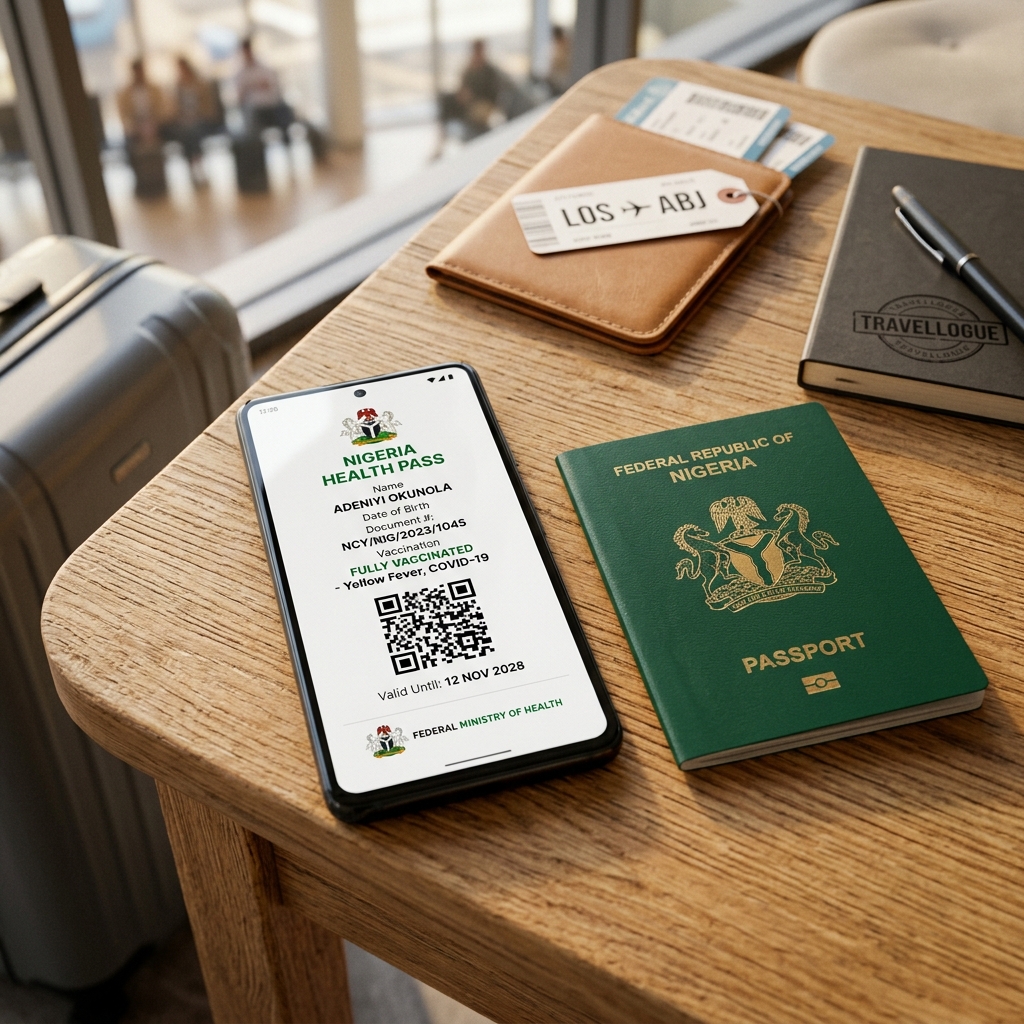
Upon exiting your flight and entering the terminal, you will encounter the Port Health Authority. Keep your Yellow Fever Card (International Certificate of Vaccination) accessible—it is a mandatory requirement for entry into Nigeria. Officers may also ask about recent travel history and general health status. Have the card physically accessible, not buried in your checked luggage.
Step 2: Immigration & Visas
Ensure your Visa on Arrival (VoA) approval letter is printed and ready, or have your standard visa, residence permit, or Nigerian passport visible. Immigration officers will:
- Examine your passport and visa documentation
- Capture your biometrics (fingerprints of all ten fingers and a facial photograph)
- Ask about the purpose and duration of your visit
- Stamp your passport with the entry date
Peak arrival times: Multiple European and Middle Eastern flights arrive between 4 PM and 7 PM, creating the longest immigration queues. If your flight arrives outside this window, queues are significantly shorter.
Step 3: Baggage Claim
Proceed to the baggage hall after clearing immigration. Key tips:
- Trolleys are free. Do not let touts convince you otherwise or attempt to charge you for using one.
- Claim stubs: Security officers may request to check your baggage tags against your boarding pass stubs before you exit the hall. Keep your boarding pass accessible.
- Waiting times: Bags typically appear 20–45 minutes after landing, depending on aircraft size and ground handling crew efficiency.
- Missing baggage: If your bag does not appear, immediately report to your airline's baggage counter (located near the carousels). File a Property Irregularity Report (PIR) and keep your reference number—you will need it for follow-up.
Step 4: Customs Exit
- Declare foreign currency exceeding $10,000 USD equivalent.
- Officers may conduct random bag searches. Stay calm and cooperative.
- The green (nothing to declare) and red (goods to declare) channel system is operational.
3. Lounges, Wi-Fi, and Facilities
If you find yourself facing an extended layover, understanding your lounge and connectivity options is essential.
Priority Pass & Business Lounges
- The SDS Lounge (MMA1): Arguably the best lounge at the airport and one of the finest in West Africa. It offers reliable, high-speed Wi-Fi (50+ Mbps), a hot Nigerian and Continental buffet refreshed throughout the day, crucial shower facilities for transatlantic travelers, dedicated nap rooms with reclining seats, and a well-stocked bar. Access via Priority Pass, DragonPass, Business Class tickets, or walk-in payment (~₦45,000–₦55,000).
- Virgin Atlantic Clubhouse: Exclusive to Upper-Class passengers and Gold Card holders, featuring a la carte dining (not buffet), a premium cocktail bar with table service, and an elegant interior. Not accessible via Priority Pass.
- Ethiopian Airlines Cloud Nine Lounge: Available to Ethiopian Airlines Business Class and Star Alliance Gold members. Features an Ethiopian coffee ceremony, hot buffet, and comfortable seating.
- Premium Lounge (MMA2): Located airside on the top floor, this lounge is excellent for domestic layovers, featuring panoramic runway views, Nigerian cuisine, fast Wi-Fi, and comfortable seating. Accessible via Priority Pass, select bank cards, and walk-in payment.
Wi-Fi Connectivity
While free Wi-Fi is advertised across the new terminal, speeds fluctuate drastically during peak evening departure hours when European and Middle Eastern flights group (5 PM–9 PM). During off-peak hours, speeds are generally adequate for browsing and email.
Connectivity alternatives:
- eSIM: Purchase an Airalo, Holafly, or Ubigi eSIM before arrival for instant data connectivity the moment you land.
- Physical SIM: Acquire an Airtel or MTN SIM card at the official kiosks in the arrivals hall. Registration takes 10–20 minutes and requires your passport and biometric capture.
- Personal hotspot: If you have a Nigerian phone with data, tethering is the most reliable option in the terminal.
Other Terminal Facilities
- Currency exchange: Official BDC kiosks in the arrivals hall offer reasonable rates. Avoid street exchangers in the parking lot.
- Food and dining: MMA1 has limited food options after security (a few cafés and snack shops). MMA2 has a significantly better food court with Nigerian and international cuisine.
- Prayer rooms: Available in both MMA1 and MMA2, clearly signposted.
- Charging stations: Scattered throughout departure lounges. Bring your own cable—outlets are UK-style three-pin (Type G).
- Pharmacies: A small pharmacy is available in the international arrivals area.
4. Transportation and Parking Logistics
Navigating away from the airport requires vigilance and planning.
Official Taxis vs Ride-Hailing
- Yellow Airport Taxis: Regulated and safe, but prices are unmetered. You must negotiate the fare before entering the vehicle. A typical ride to Victoria Island or Lekki in 2026 will range between ₦15,000 and ₦25,000. To Ikeja or Maryland, expect ₦5,000–₦8,000.
- Uber / Bolt: Widely used and generally 20–40% cheaper than airport taxis. However, union restrictions often prevent ride-hailing drivers from parking directly at the arrivals door. You will likely need to walk to the designated public car park (5–10 minutes from the terminal exit) to meet your driver. The app will show you the exact pick-up point.
- Hotel transfers: Many hotels offer complimentary or paid airport shuttles. This is the most stress-free option—arrange it with your hotel before arrival.
Airport Parking Options
- MMA2 Multi-Story Car Park: The best parking at Lagos Airport—secure, covered, monitored by CCTV, and sheltered from rain and sun.
- Hourly rate: ~₦500
- Overnight rate: ~₦3,000
- Weekly rate: ~₦15,000
- International Terminal (MMA1) Parking: Open-air parking is available directly outside the terminal. It is less secure than the MMA2 multi-story but more convenient for international travelers. Rates are similar.
5. Security Tips & Scams to Avoid
To ensure a stress-free experience at Lagos Airport, keep these final safety tips in mind:
- Extortion attempts: "Dash me something" (asking for a tip) is common from both official-looking and unofficial personnel. You are not obligated to tip security, immigration, or customs officers. A polite, firm "I only have my cards" or "I don't have anything, officer" is generally accepted without confrontation.
- Touts and "Area Boys": Ignore anyone trying to forcefully grab your bags outside the terminal. Do not accept unsolicited help from people not in official FAAN uniforms. If you need a porter, request one from the uniformed staff inside the terminal.
- Currency exchange scams: Only use the official Bureau de Change (BDC) kiosks inside the arrival hall. The men whispering "Dollar, Pound, Euro" in the parking lots pose genuine risks of counterfeit notes, short-counting, and theft.
- Immigration scams: No one should ask you for money to "speed up" your immigration process. If someone approaches you in the queue offering fast-track services for a fee, decline and report them to the nearest uniformed officer.
- WiFi security: Free airport Wi-Fi is unencrypted. Avoid logging into banking apps or entering sensitive passwords without a VPN active.
- Luggage security: Keep your bags in sight at all times in the arrivals hall. Use TSA-approved combination locks on checked luggage rather than padlocks, which are frequently cut by security during inspections.
Lagos Airport is a bustling reflection of Nigeria itself—vibrant, loud, and full of energy. By understanding the terminal layouts, knowing your rights, planning your transport, and maintaining awareness of your surroundings, navigating LOS in 2026 can be a remarkably smooth experience. The airport has improved dramatically in recent years, and with each terminal upgrade, the experience moves closer to international standards.
Our Team
Airports.ng is powered by a team of aviation journalists, travel industry professionals, and technology experts passionate about making travel information accessible to all Nigerians.
Related Articles
The Ultimate Lagos Airport (LOS) Terminal Transfer Guide: Connecting International and Domestic Flights Without Stress (2026)
Everything you need to know about transferring between international (MMIA) and domestic (MMA2/GAT) terminals at Lagos Airport in 2026.
The Ultimate Step-by-Step Guide to Getting the Nigeria e-Yellow Card Online (2026)
A complete step-by-step guide to obtaining the mandatory digital e-Yellow Card in Nigeria, including official Remita fees, the online portal, and registration steps.